Replacement Cost vs. Actual Cash Value: What’s the Difference?
When reviewing your insurance policy, you may see the terms replacement cost and actual cash value. These terms can make a big difference in how much you receive after a covered claim.
Understanding the difference can help you avoid surprises and make better decisions about your home, auto, and personal property insurance.
What Is Replacement Cost?
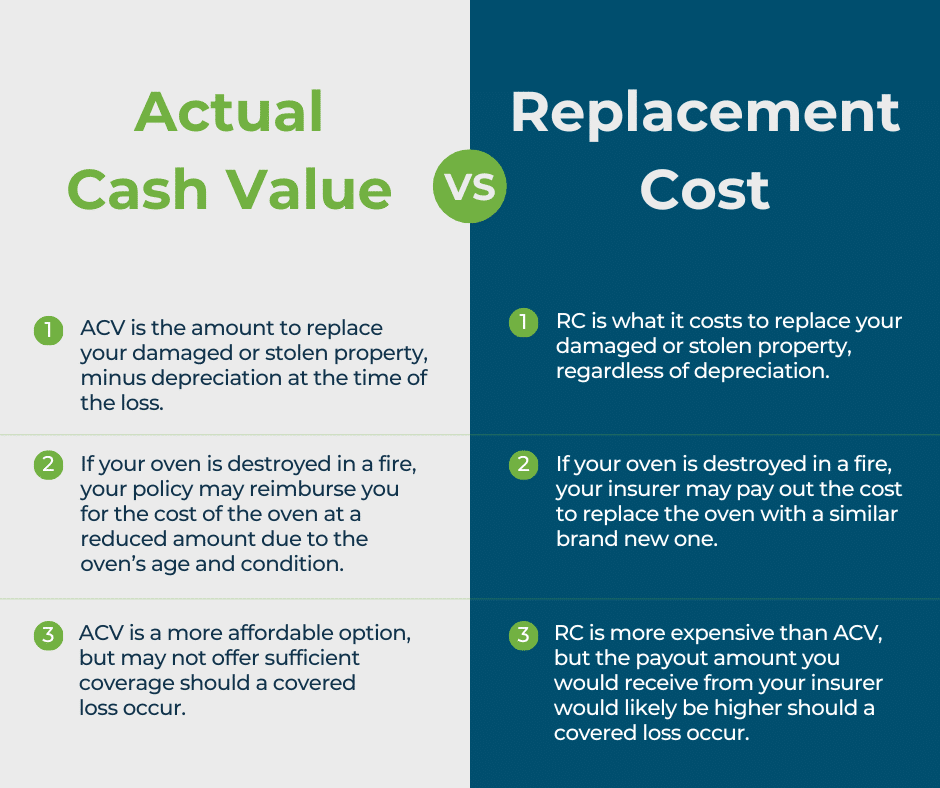
Replacement cost coverage helps pay to repair or replace damaged property with new property of similar kind and quality, without subtracting for depreciation.
Depreciation is the loss in value that happens over time due to age, use, wear and tear, or condition.
For example, if your roof, furniture, or electronics are damaged in a covered loss, replacement cost coverage may help pay what it costs to replace them today, subject to your policy limits, deductible, and coverage terms.
What Is Actual Cash Value?
Actual cash value, often called ACV, generally means replacement cost minus depreciation.
In other words, actual cash value considers the age and condition of the damaged property at the time of the loss.
For example, if you bought a couch several years ago and it is damaged in a covered claim, an actual cash value settlement may pay based on what that couch was worth immediately before the loss—not what it costs to buy a brand-new couch today.
A Simple Example
Let’s say your television is damaged in a covered loss.
-
Cost to buy a comparable new TV today: $1,000
-
Depreciation due to age and use: $400
-
Actual cash value: $600
With replacement cost coverage, you may be reimbursed based on the cost to replace the TV with a comparable new one, subject to your deductible and policy terms.
With actual cash value coverage, your payment may be based on the depreciated value of the TV.
This difference can have a major impact after a claim.
Why This Matters
Many policyholders do not realize how much depreciation can reduce a claim payment until after a loss happens.
Replacement cost coverage can provide broader protection because it may help you replace damaged property with new items. Actual cash value coverage may cost less in premium, but it can leave you with more out-of-pocket expense after a claim.
Where You May See These Terms
Replacement cost and actual cash value can apply to different parts of an insurance policy, including:
-
Your home
-
Your roof
-
Personal belongings
-
Detached structures
-
Business property
-
Vehicles, in certain situations
It is important to review each part of your policy because some items may be covered differently than others.
For example, your home may be insured on a replacement cost basis, while your roof or personal property may have limitations, endorsements, or depreciation rules.
Roof Coverage Is Especially Important
Roof claims are one area where replacement cost and actual cash value matter a great deal.
Some homeowners policies provide replacement cost coverage for roof damage, while others may pay based on actual cash value, especially as the roof gets older.
If your roof is covered on an actual cash value basis, depreciation may significantly reduce your claim payment after wind or hail damage.
Replacement Cost Does Not Mean Unlimited Coverage
Replacement cost coverage is valuable, but it does not mean your policy pays unlimited amounts.
Your claim payment is still subject to:
-
Policy limits
-
Deductibles
-
Covered causes of loss
-
Exclusions
-
Required documentation
-
Policy conditions
That is why choosing the right coverage limits is just as important as understanding the type of valuation your policy uses.
Which Option Is Right for You?
The right choice depends on your budget, property, and risk tolerance.
Replacement cost coverage may be a good fit if you want stronger protection and would have difficulty paying the difference out of pocket after a loss.
Actual cash value coverage may have a lower premium, but it is important to understand the potential tradeoff. A lower premium today could mean a smaller claim payment tomorrow.
Review Your Policy Before a Claim Happens
The best time to understand your coverage is before you need to use it.
A licensed insurance agent can help you review your policy and answer important questions such as:
-
Is my home insured for replacement cost?
-
Are my personal belongings covered for replacement cost or actual cash value?
-
How is my roof covered?
-
Are there special limits on certain items?
-
Do I need to update my coverage limits?
We’re Here to Help
Insurance policy language can be confusing, but you do not have to figure it out alone.
Our agency can help you understand the difference between replacement cost and actual cash value, review your current coverage, and identify potential gaps before a claim occurs.
Knowing how your policy responds after a loss can help you protect your home, belongings, and financial future with greater confidence.